Umami is the fifth basic taste, alongside sweetness, saltiness, sourness and bitterness. Our sense of taste does more than simply allow us to enjoy food. Sweetness signals sugars that provide energy, while saltiness helps us detect sodium, an essential mineral. Sourness and bitterness can sometimes serve as warning signals, helping us avoid potential dangers such as spoiled or toxic food.
What, then, does umami tell us?
Umami is closely linked to our ability to detect amino acids, the building blocks of proteins essential for the growth and maintenance of our bodies. We perceive umami when our tongue detects certain amino acids in food and compounds that interact with them.
The Three Main Components of Umami
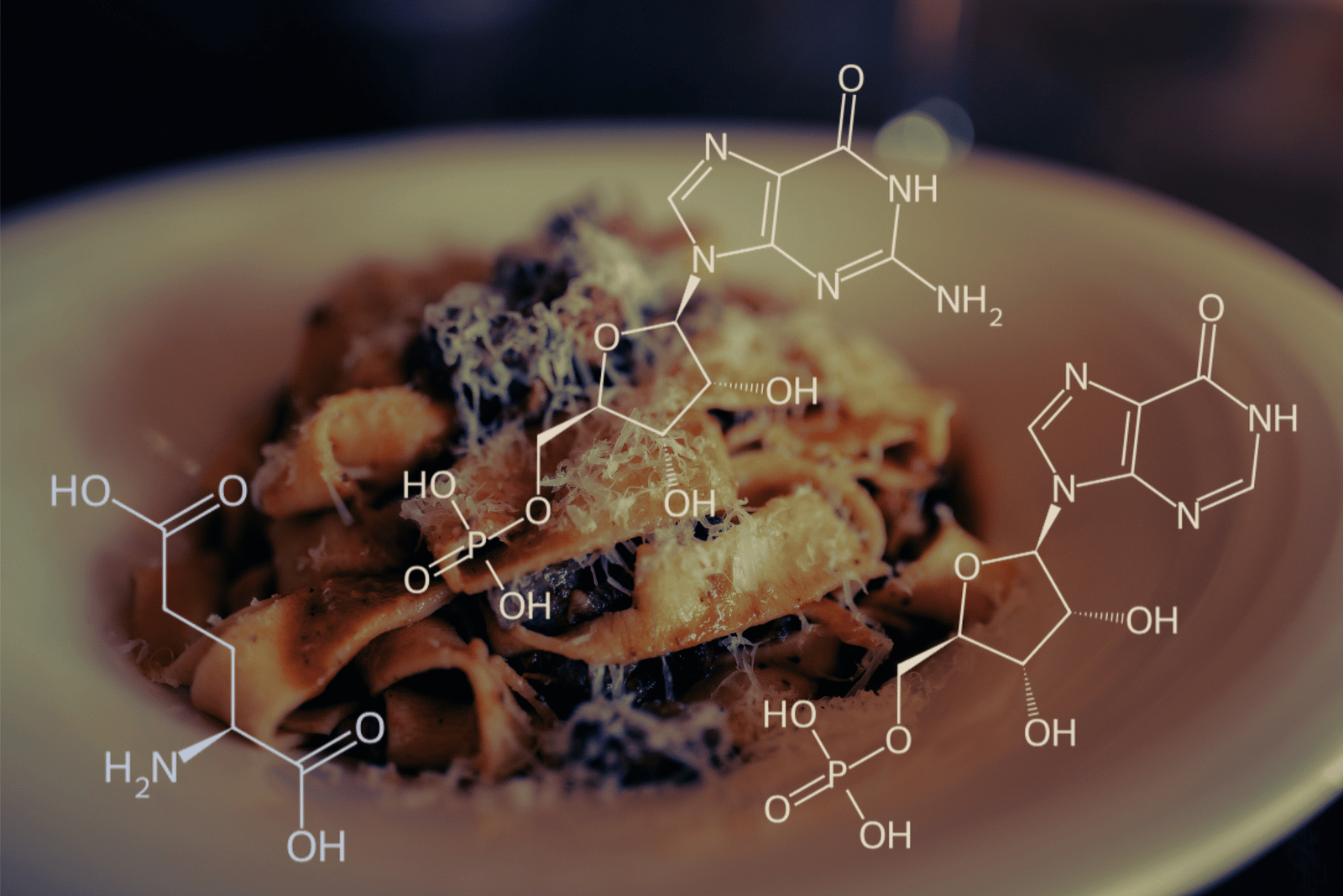
Three compounds are central to understanding umami: glutamate (glutamic acid), inosinate (inosinic acid) and guanylate (guanylic acid).
- Glutamate — One of the 20 amino acids that make up proteins. It is found in a wide range of plant-based and animal-derived foods and is a major contributor to umami.
- Inosinate and guanylate — Both are nucleotides. Inosinate is found mainly in meat and fish, while guanylate is particularly abundant in dried shiitake mushrooms.
Each of these compounds tastes of umami on its own. However, certain combinations are known to produce a much stronger umami sensation than the individual compounds alone.
Where Is Umami Found?
There are two main ways in which umami compounds occur in food.
The first is their natural presence in foods without any processing. Ripe tomatoes, meat, fish and shellfish naturally contain free glutamate and nucleotide-based umami compounds.
However, much of the umami in food is brought out by human intervention rather than simply being found — through processes such as drying, fermentation and ageing. These processes enhance the umami in ingredients or make it easier to perceive, each through a different mechanism. (*1)
Moreover, these processes were not originally developed with the intention of creating umami. They evolved as ways of preserving food to survive periods of scarcity or to keep it through changing seasons and long journeys. Along the way, the taste of food also changed. As a result, a deeper umami taste sometimes emerged.
Umami Synergetic Effect
When glutamate meets inosinate or guanylate, the result is not simply the sum of the two, but a synergistic effect resembling multiplication. In a study involving human participants, the perceived umami intensity of a mixture containing glutamate and inosinate in approximately equal proportions was reported to be about eight times that of glutamate alone. (*2)
For instance, ragù made with tomatoes and meat, pot-au-feu with simmered vegetables and beef, and risotto with cheese and mushrooms. The umami synergy between different ingredients is at work in these dishes.
Umami synergy is nothing unusual; it has long been part of home cooking in different parts of the world.
*1: The mechanisms by which processing changes umami are not uniform. For example, fermentation and ageing can increase free glutamate through the breakdown of proteins. By contrast, different mechanisms are involved in the formation and transformation of nucleotides.
*2: Umami Information Center: https://www.umamiinfo.com/what/whatisumami/